- The Lounge
- Posts
- How Doctor Shortages Are Undermining American Healthcare
How Doctor Shortages Are Undermining American Healthcare
Fear blocks AI adoption / Strategy requires inclusive participation / H.R.1 offers small business relief

Dr. Mike Woo-Ming
December 24, 2025

The LOUNGE - A Newsletter for Savvy Physicians
We scour the net, selecting the most pertinent articles for the busy doc so you don’t have to! Here’s what kept our focus this week…
America spends more on health care than any nation on earth, yet patients are waiting longer, paying more, and getting less.
Personal experiments showed AI can amplify human creativity rather than replace it.
Even the clearest CEO pitch can leave your leadership team out of the real strategy.
The One Big Beautiful Bill Act isn’t just long—it could save your small business serious money.
Hospitals never close for Christmas, and neither do the physicians keeping them running.
The future of medicine isn’t just about new drugs—it’s about sustainable production from day one.
Thank You to our Sponsor:
Lightstone DIRECT invites you to partner with a $12B AUM real estate institution as you grow your portfolio. Access the same single-asset multifamily and industrial deals Lightstone pursues with its own capital – Lightstone co-invests a minimum of 20% in each deal alongside individual investors like you. You’re an institution. Time to invest like one. Click Here!

Why Physicians Are Co-Investing in $55M Deals with a $12B Real Estate Giantr
What if physicians could co-invest in $55M industrial parks alongside a $12B family office without $100K consultants or high-risk leverage?
In this insightful episode, Dr. Mike Woo-Ming interviews Jonathan Spitz from Lightstone Direct, the new direct-to-investor arm of 40-year-old powerhouse Lightstone Group. Jonathan shares the firm’s vertically integrated model (25K apartments, 12M sq ft industrial, 5K hotel keys), why they commit 20% of their own capital first (5-10x industry norms), and how physicians can diversify beyond stocks or DIY rentals. He breaks down direct vs. passive CRE, asset class pitfalls (office flops vs. industrial wins), and red flags like inexperienced managers or 85% debt. With examples like their Greenville industrial deal, Jonathan proves alignment and conviction drive better outcomes empowering busy doctors to build legacy wealth safely..
Join Doctors Online Success
A free discussion forum exclusively for physicians! Connect with like-minded doctors, share insights, and gain valuable strategies for success in medicine and beyond. Don't miss out—sign up today and start the conversation!
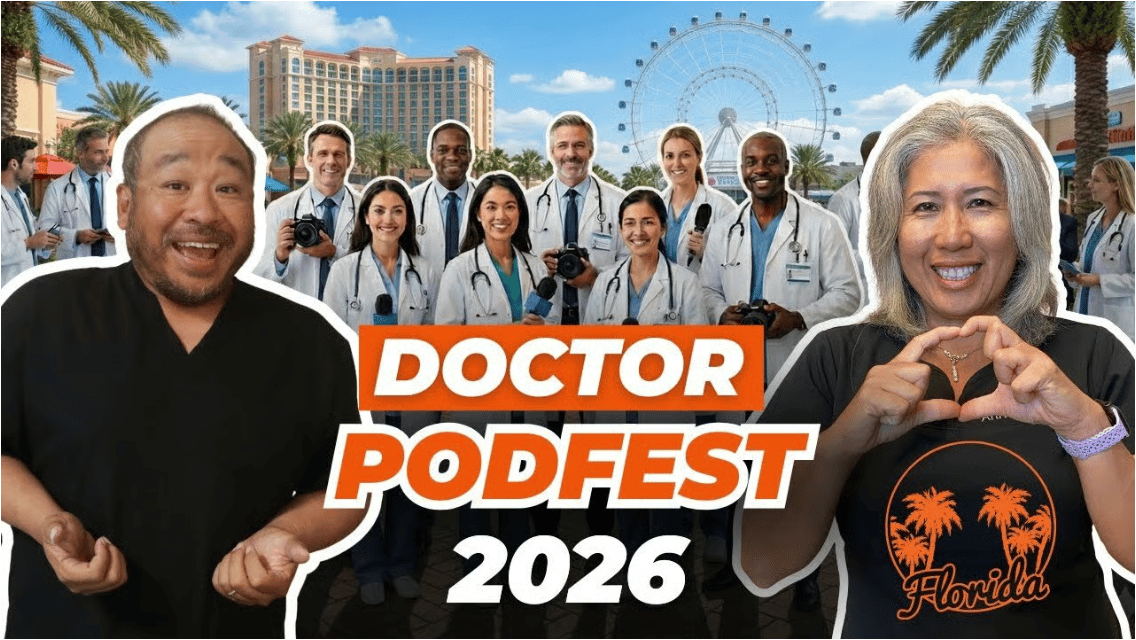
You Are Invited: Doctor PodFest 2026 🎙️
Doctors, your expertise deserves a bigger stage. Doctor PodFest 2026, January 15 in Orlando, is your chance to start or grow a podcast, connect with 100+ physician creators, and discover new ways to earn outside insurance. Four days of training, brand introductions, and actionable strategies await. Become more than a clinician—be a mentor, guide, and influencer.

LOUNGE TALK
In this editorial, a retired physician argues that U.S. health care has deteriorated into an inefficient, profit-driven system that increasingly fails both patients and doctors. Drawing from personal experience as a caregiver, he highlights severe physician access shortages that push patients toward non-physician providers, often by necessity rather than choice. While non-physicians can deliver compassionate and timely care, their expanding role reflects systemic dysfunction rather than thoughtful reform. The author sharply criticizes private equity’s growing control of medical practices, citing reduced visit times, higher costs, and pressure on physicians to prioritize profits over patients. He also condemns administrative bloat, noting that health care dollars disproportionately flow to executives, investors, and shareholders. Pharmaceutical pricing practices are portrayed as extreme and politically protected, further burdening patients. Despite reviewing common policy proposals, the author concludes with no clear solutions—only a warning that access, quality, and trust in U.S. health care are eroding fast.
In this essay, Eric Laughlin argues that successful AI transformation is fundamentally a human challenge, not a technical one. His perspective shifted through personal experimentation with AI in music, where the tools amplified his creativity rather than replacing it. That experience shaped his leadership approach at Agiloft, where AI adoption began with playful exploration instead of mandates. By encouraging employees to experiment in their personal lives, fear gave way to curiosity and excitement. Laughlin describes building lightweight structures—like an AI Council and later an AI Ops team—to scale learning without killing experimentation. He emphasizes breaking down organizational silos so AI can optimize workflows across functions rather than reinforce rigid roles. Ultimately, he contends that companies that thrive with AI will be human-powered first, with leaders who protect curiosity, support learning, and guide mindset shifts alongside technology.
Support Our Sponsor: Student Loan Planner
Concerned about medical student loans? It's time for a custom action plan. Talk with these experts who've helped over 11,000 borrowers take on $2.5 billion in student debt. Book your meeting today!
David Lancefield explores how CEOs often present strategy to senior leaders in ways that are compelling but can inadvertently limit real engagement. Using the example of a media CEO named John, he shows that a well-delivered strategy meeting can create alignment and excitement while subtly signaling that leaders should absorb and execute rather than actively contribute. While clarity and persuasion are valuable, overemphasis on narrative can stifle dialogue and deeper input from the broader leadership team. Lancefield suggests that extending strategic involvement beyond the C-suite encourages ownership, diverse perspectives, and more effective execution. Simply presenting strategy risks turning leaders into passive implementers rather than active shapers. Involving a wider group early can surface blind spots and strengthen commitment. The takeaway: strategy is stronger when it’s co-created, not just communicated.
The One Big Beautiful Bill Act (H.R.1), signed into law in July 2025, introduces over 100 tax-related provisions that can significantly benefit small businesses. Key changes include enhanced childcare and paid family leave credits, which can help employers attract and retain talent while lowering tax liability. The Act also allows immediate deduction of domestic R&D expenses, providing flexibility and potential retroactive benefits for small businesses with receipts under $31 million. New deductions for qualified overtime and tips are retroactively applicable to 2025, with clear guidance on how to calculate and document them. Payroll, recordkeeping, and employee communication may require updates to take full advantage of these provisions. Treasury and IRS guidance is expected to further clarify implementation, but proactive preparation can help businesses maximize savings. Overall, the Act represents a substantial opportunity to optimize tax strategy while investing in employee benefits and innovation.
Nirav Shah explores the harsh reality of physicians working through the holidays while the rest of the world celebrates. Physicians often cover high-stress shifts without adequate compensation, while administrators enjoy paid time off, creating a system that prioritizes cost savings over frontline support. Locum and early-career physicians often take holiday shifts out of financial necessity, whereas more established doctors can protect their time. Beyond the workload, physicians face family expectations and social pressures that compound stress, making holidays a no-win situation. This “nobility trap” leverages doctors’ commitment to patient care to justify understaffing and operational inefficiencies. Chronic understaffing, combined with misaligned incentives, drives burnout and leads many physicians to leave clinical practice. Shah argues the solution is straightforward: fair compensation, adequate staffing, and holding administrators accountable to the conditions they create.
Jim Greffet explores how the pharmaceutical industry can achieve growth without compromising sustainability. He emphasizes that delivering innovative medicines to patients requires robust manufacturing and supply chains designed with environmental responsibility in mind. New facilities are being built with clean energy, flexible production lines, and smart systems that maximize output while minimizing waste and emissions. AI and data analytics help identify inefficiencies, enabling smarter decision-making and more reliable supply. Investments in renewable energy, automation, and adaptable designs turn each step of growth into an opportunity to strengthen both business and environmental outcomes. Sustainability isn’t an afterthought—it’s embedded from the ground up. By reimagining operations, the industry can meet tomorrow’s health demands while driving meaningful, measurable environmental progress.
WANT TO REACH THOUSANDS OF FORWARD-THINKING PHYSICIANS? CONSIDER SPONSORSHIP. CONTACT US FOR DETAILS.

QUICK BITES
7 hidden costs that are eating up your small business.
The power of affirmation at work.
The real reason your meetings go off the rails.
The consequences of adopting AI in medicine.
Like the newsletter? Share it with someone you know! If you have any feedback or suggestions for future issues, please don’t hesitate to reach out!
“You may be disappointed if you fail, but you are doomed if you don't try."